What's included
- 12 lessons with clear explanations, clinical examples and diagrams
- 19 TherapyAid worksheets and forms (fillable PDFs) to use with your own clients
- Final quiz with unlimited retakes (pass mark 80%)
- Certificate of completion for 6 hours, with a verification ID
- Lifetime access, self-paced on any device
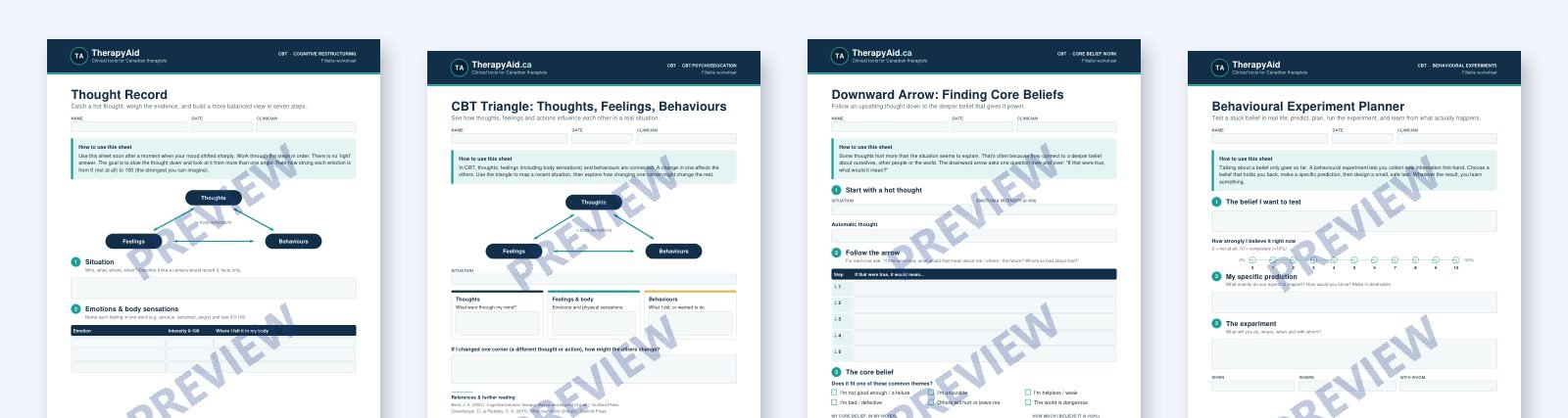
See all 19 worksheets included
- CBT at a Glance: Clinician Quick Guide
- CBT Triangle: Thoughts, Feelings, Behaviours
- Problem List and Therapy Goals
- Downward Arrow: Finding Core Beliefs
- Rules for Living and Assumptions
- Core Beliefs Checklist
- My Session Summary and Takeaways
- Structured Problem-Solving
- Breaking the Procrastination Cycle
- Socratic Questions for Challenging Thoughts
- Thinking Traps: Spot and Reframe
- Double Standard Technique
- Thought Record (7 columns)
- Simple 3-Column Thought Log
- Strengths and Positive Qualities Log
- Anxious Predictions Log
- Behavioural Experiment Planner
- Decatastrophizing: Worst, Best and Most Likely
- Coping Cards
Single-clinician licence: use, print and share them with your own clients.
About Course
A practical introduction to Cognitive Behavioural Therapy for clinicians. You will learn the cognitive model, how to build a case formulation, how to structure a CBT session, and how to use core techniques such as Socratic questioning, thought records, behavioural activation and graded exposure. Each module includes a short video, a workbook exercise and a case example. The course ends with a quiz and a certificate of completion.
What you will learn
- Explain the cognitive model and how thoughts, emotions, body sensations and behaviours interact.
- Develop a basic CBT case formulation from an intake interview.
- Structure a CBT session using agenda setting, homework review and summaries.
- Use Socratic questioning and thought records to help clients evaluate unhelpful thoughts.
- Apply behavioural activation and graded exposure with common presentations.
- Plan for relapse prevention and adapt CBT respectfully for clients from diverse cultural backgrounds.
Certificate
Complete every lesson and pass the final quiz (80% or higher, unlimited retakes) to download your certificate of completion for 6 hours.
Continuing competence: check how this course applies to your regulatory college’s requirements. Course content is educational and is not clinical supervision or consultation about specific clients.
Your instructor
Mukesh Mishra, MSW, is a Registered Clinical Social Worker in Alberta and British Columbia, a Registered Social Worker in Ontario and an ACSW-approved clinical supervisor. He is the founder of Disha Counselling & Wellness Centre in Edmonton. He is a Diplomate of the Academy of Cognitive and Behavioral Therapies (A-CBT) and uses CBT every day with adults experiencing anxiety and depression. As a clinical supervisor he teaches new clinicians how to turn CBT theory into structured, effective sessions.
Course Content
Module 1: The Cognitive Model
-
What CBT is, and what it is not
25:00 -
Thoughts, feelings, body and behaviour
30:00