What's included
- 8 lessons with clear explanations, clinical examples and diagrams
- 20 TherapyAid worksheets and forms (fillable PDFs) to use with your own clients
- Final quiz with unlimited retakes (pass mark 80%)
- Certificate of completion for 3 hours, with a verification ID
- Lifetime access, self-paced on any device
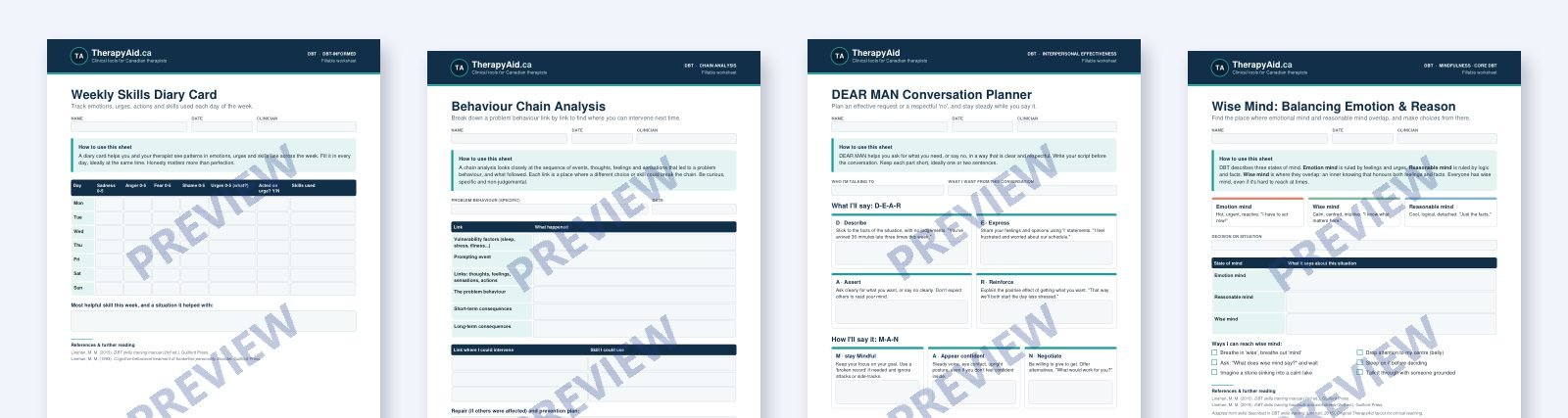
See all 20 worksheets included
- Both-And Thinking (Dialectics)
- Emotional Dysregulation, Explained
- DBT at a Glance: Clinician Quick Guide
- Weekly Skills Diary Card
- Wise Mind: Balancing Emotion and Reason
- Mindfulness WHAT and HOW Skills
- Daily Mindfulness Practice Log
- STOP Skill Practice Card
- TIPP: Fast Body-Based Crisis Skills
- Radical Acceptance Practice
- Self-Soothe With the Five Senses
- Check the Facts
- Emotion Diary
- Opposite Action Planner
- PLEASE Skills: Body Care Tracker
- DEAR MAN Conversation Planner
- GIVE: Keeping Relationships Strong
- FAST: Keeping Your Self-Respect
- Behaviour Chain Analysis
- Cope Ahead Plan
Single-clinician licence: use, print and share them with your own clients.
About Course
A practical, skills-focused introduction to using Dialectical Behaviour Therapy skills in individual counselling. Learn the biosocial model and dialectical stance, then how to teach and coach core skills from the four DBT modules: mindfulness, distress tolerance, emotion regulation and interpersonal effectiveness. Includes diagrams, skill handouts, practice activities, case vignettes and a final quiz. This course teaches DBT-informed skills use; it does not certify clinicians to deliver comprehensive DBT.
What you will learn
- Explain the biosocial model and the dialectic of acceptance and change.
- Distinguish comprehensive DBT from DBT-informed skills work in individual practice.
- Teach core mindfulness skills, including wise mind and the "what" and "how" skills.
- Coach distress tolerance skills such as STOP, TIPP and radical acceptance.
- Apply emotion regulation skills including check the facts, opposite action and PLEASE.
- Use DEAR MAN, GIVE and FAST to build interpersonal effectiveness.
Certificate
Complete every lesson and pass the final quiz (80% or higher, unlimited retakes) to download your certificate of completion for 3 hours.
Continuing competence: check how this course applies to your regulatory college’s requirements. Course content is educational and is not clinical supervision or consultation about specific clients.
Your instructor
Mukesh Mishra, MSW, is a Registered Clinical Social Worker in Alberta and British Columbia, a Registered Social Worker in Ontario and an ACSW-approved clinical supervisor. He is the founder of Disha Counselling & Wellness Centre in Edmonton. He has advanced training in DBT and is a Diplomate of the Academy of Cognitive and Behavioral Therapies (A-CBT). He teaches DBT skills in individual therapy and supervises clinicians who are adding skills coaching to their practice.
Course Content
Module 1: Foundations of DBT
-
The biosocial model and the dialectical stance
18:00 -
Comprehensive DBT vs DBT-informed skills work
17:00