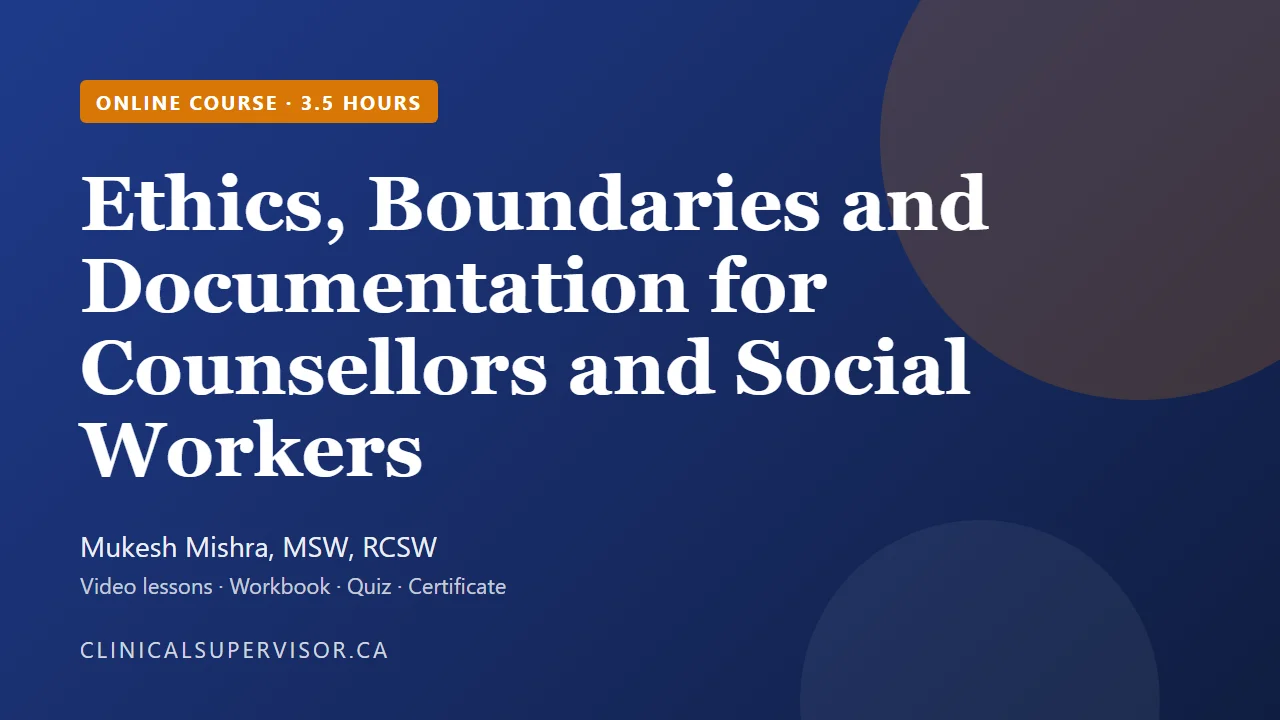
What's included
- 8 lessons with clear explanations, clinical examples and diagrams
- 10 TherapyAid worksheets and forms (fillable PDFs) to use with your own clients
- Final quiz with unlimited retakes (pass mark 80%)
- Certificate of completion for 3.5 hours, with a verification ID
- Lifetime access, self-paced on any device
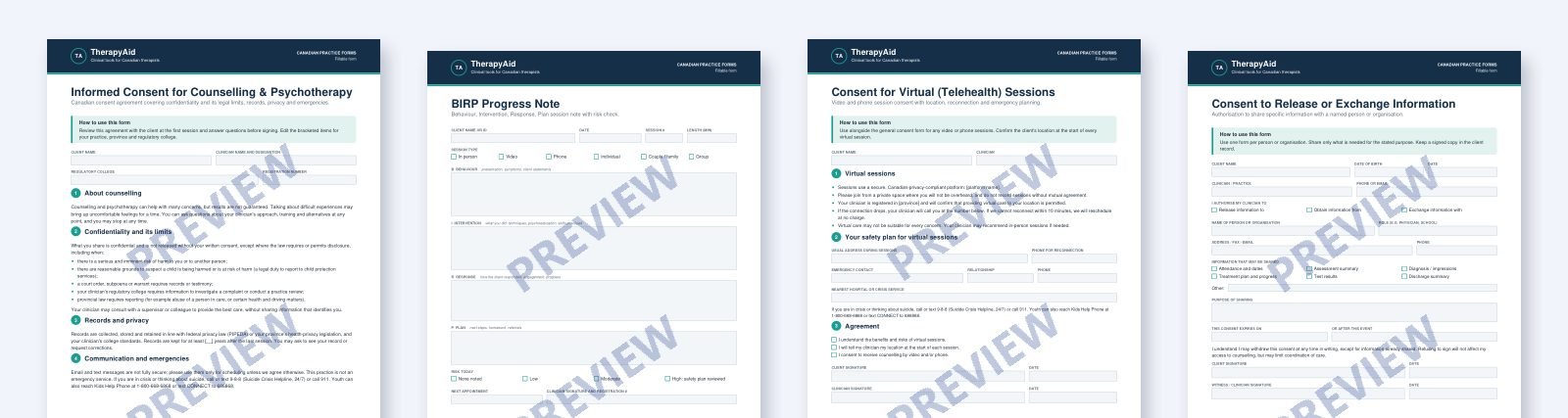
See all 10 worksheets included
- Informed Consent for Counselling and Psychotherapy
- Consent for Counselling a Minor
- Consent to Release or Exchange Information
- Privacy Notice and Acknowledgement
- Safety Plan
- SOAP Progress Note
- DAP Progress Note
- BIRP Progress Note
- Consent for Virtual (Telehealth) Sessions
- Fees, Cancellation and Payment Agreement
Single-clinician licence: use, print and share them with your own clients.
About Course
A practical ethics course for everyday clinical work. Learn a step-by-step ethical decision-making model, how to obtain meaningful informed consent, the limits of confidentiality, how to tell boundary crossings from boundary violations (including in small and cultural communities and online), and how to write clear, defensible clinical records. The course also covers ethics in virtual care and private practice. Content reflects shared principles of Canadian codes; learners must apply the specific standards of their own regulatory college and provincial legislation. Includes diagrams, case vignettes, a decision-making worksheet, a documentation checklist and a final quiz.
What you will learn
- Apply a structured ethical decision-making model to practice dilemmas.
- Obtain and document informed consent, including for minors and virtual care.
- Explain the limits of confidentiality and how they vary by jurisdiction.
- Distinguish boundary crossings from boundary violations and manage dual relationships.
- Write clear, objective, timely clinical documentation.
- Identify ethical issues in virtual care, social media and private practice.
Certificate
Complete every lesson and pass the final quiz (80% or higher, unlimited retakes) to download your certificate of completion for 3 hours.
Continuing competence: check how this course applies to your regulatory college’s requirements. Course content is educational and is not clinical supervision or consultation about specific clients.
Your instructor
Mukesh Mishra, MSW, is a Registered Clinical Social Worker in Alberta and British Columbia, a Registered Social Worker in Ontario and an ACSW-approved clinical supervisor. He is the founder of Disha Counselling & Wellness Centre in Edmonton. As an ACSW-approved clinical supervisor and a designated capacity assessor in Alberta, he reviews documentation, consent and risk decisions with supervisees every week, and runs a busy private practice.
Course Content
Module 1: Ethical Decision-Making
-
Codes, standards and the law
17:00 -
A step-by-step decision-making model
22:00