What's included
- 8 lessons with clear explanations, clinical examples and diagrams
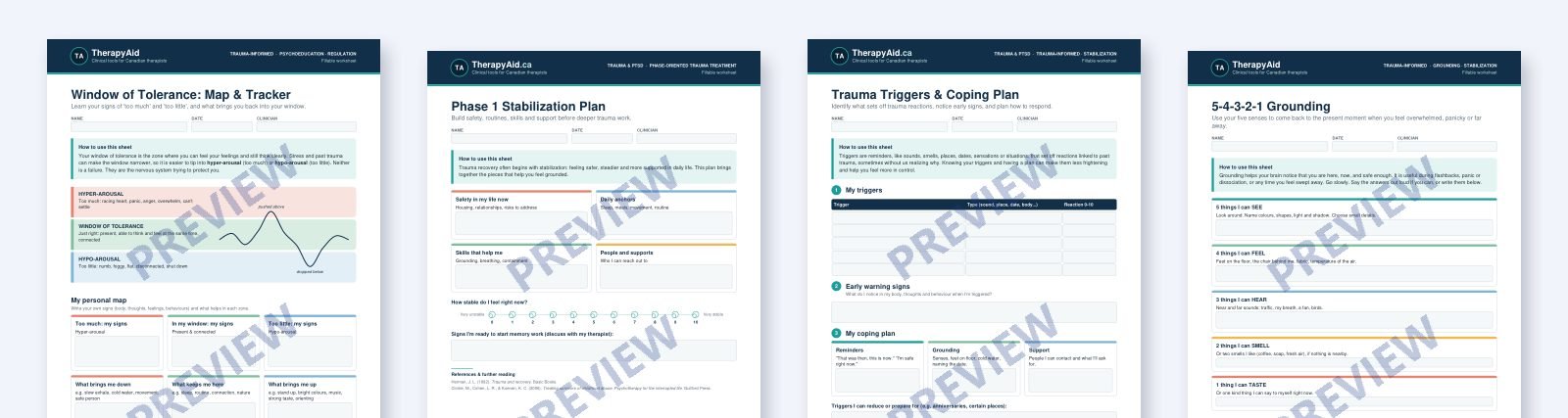
- 10 TherapyAid worksheets and forms (fillable PDFs) to use with your own clients
- Final quiz with unlimited retakes (pass mark 80%)
- Certificate of completion for 3 hours, with a verification ID
- Lifetime access, self-paced on any device
See all 10 worksheets included
- Understanding Trauma Responses
- PTSD and Complex PTSD Explained
- Trauma-Informed Care Principles: Quick Guide
- 5-4-3-2-1 Grounding
- 30 Grounding Techniques
- Window of Tolerance: Map and Tracker
- Flashback First Aid Card
- Phase 1 Stabilization Plan
- Trauma Triggers and Coping Plan
- Operational Stress Check-In
Single-clinician licence: use, print and share them with your own clients.
About Course
Newcomers to Canada may carry trauma from before, during and after migration, and face daily stressors that make healing harder. This course teaches a practical, trauma-informed approach: understanding the three phases of migration stress, applying the principles of trauma-informed care, working effectively with interpreters, stabilisation and grounding skills, phase-based treatment, and protecting yourself from vicarious trauma. Includes diagrams, a grounding skills handout, an interpreter briefing checklist, case vignettes and a final quiz.
What you will learn
- Describe pre-migration, migration and post-migration stressors and their mental health impact.
- Apply the six principles of trauma-informed care in practice with newcomers.
- Work effectively and ethically with professional interpreters.
- Teach stabilisation and grounding skills suited to diverse clients.
- Explain phase-based trauma treatment and when to refer for specialised therapy.
- Recognise and manage vicarious trauma in yourself and your team.
Certificate
Complete every lesson and pass the final quiz (80% or higher, unlimited retakes) to download your certificate of completion for 3 hours.
Continuing competence: check how this course applies to your regulatory college’s requirements. Course content is educational and is not clinical supervision or consultation about specific clients.
Your instructor
Mukesh Mishra, MSW, is a Registered Clinical Social Worker in Alberta and British Columbia, a Registered Social Worker in Ontario and an ACSW-approved clinical supervisor. He is the founder of Disha Counselling & Wellness Centre in Edmonton. He has advanced training in EMDR and works daily with trauma, including with newcomer and refugee clients. He provides counselling in English, Hindi, Nepali, Punjabi and Urdu, and is a Diplomate of the Academy of Cognitive and Behavioral Therapies (A-CBT).
Course Content
Module 1: Migration, Trauma and Mental Health
-
The three phases of migration stress
18:00 -
How trauma shows up across cultures
27:00